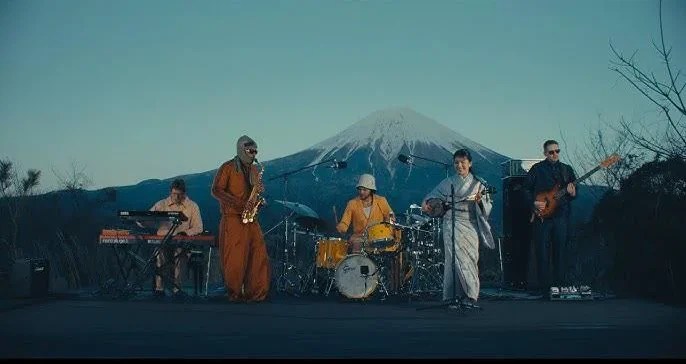
Yussef Dayes is a British drummer and composer, who makes music which moves me. He recently released a short documentary, Yussef Dayes In Japan (Film) 富士山. I’ve loved jazz since I was in my early teens. It began with Billie Holiday and expanded over the years. Something about the modern crop of jazz artists like Dayes, Corto Alto, Nubya Garcia, and Kamasi Washington sparks fires of creativity within me.
As mentioned in my previous post, my summer project has been working through Micah Lee’s ‘Hacks Leaks and Revelations‘. I’m not finished yet. It’s clear that investigative, analytical work sparks inspiration. This work requires a deep, meticulous, slow burn. I’m keen to continue focusing on this aspect. I want to develop digital forensic skills and penetration testing skills and connect these to my reporting and investigative skills. There’s alignment there, and this is why I mention music.
Like many and indeed, most art forms, music can be a gateway to new ideas and approaches. It can show how seemingly disparate elements interact. For example, drum n bass fits beautifully with a jazz run on saxophone. In his trip to Japan, Dayes talks beautifully about his connection to Eastern philosophy – rooted in childhood – and how he appreciates the attention to detail and reverence for mindfulness that imbues much of what makes Japanese culture unique. From the jazz kissa to enso calligraphy and taiko drums; Dayes leans into it all and finds alignment and inspiration. This is key for me – lessons from lands beyond our own horizon. I don’t mean this strictly literally. Though I do think this is vital. Rather, it involves the intentional exploration of experiences and concepts outside of our current scope.
On Saturday morning, I sat over espresso in a lovely little hole in the wall cafe. I began thinking about all of this while I chatted with a friend about Indian Raga. He is a classically trained musician who has played in jazz projects for years and also studied global music, so he’s a wealth of intel on structure and application. When I quizzed him on Raga he explained once having had the pleasure of seeing Anoushka Shankar perform for hours which felt like minutes. As he described, the structure of Raga keeps gradually ascending in a subtle way. Then, just as the music nears its crescendo, the musician will tease it and pull back a few times. They can do this only as they understand and respect the rules of Raga. He also enjoys coding, so he likened it to code, there are rules but there is room to interpret and apply those rules. This was something I did not understand about coding until the last year or so; to discover the creative potential was magic.
This adherence to a framework shows much of what I’ve experienced in my cybersecurity journey. There is the ability to create within it. Constraints certainly, but creativity there to be leveraged and applied; such as solving problems or fortifying surfaces. I find this terribly exciting. I like constraints and systems. I’m also very keen to create. Interestingly, sometimes a lack of constraints can be counterintuitive to creativity.
Listening to diverse music stokes the creative fire. Discovering and developing new opportunities to learn excites me. Applying frameworks to better understand complex concepts is a groove I can certainly get behind. I’m grateful to live in a world where I can access so much information and inspiration. My future goals are to pay it forward in more ways. Right now, I’m sharing my lessons here. I hope this sparks little fires of inspiration in others.
 Seeline CYBER
Leave a comment